Modeling the Great Takeoff: Collective Intelligence for the Future of Growth
January 15, 2026
What we take for granted today - modern life, global wealth, rapid technology, abundance - is a recent departure from thousands of years of stagnation, born from the Great Takeoff merely two centuries ago. If human society once ignited this innovation engine, could AI model this process and help trigger a second takeoff? Is today’s AI mature enough to replicate the core dynamics of creative destruction, and where do the gaps remain? This article argues that beyond making AI smarter as isolated individuals, the missing research frontier is building AI as a collaborative, societal innovation system.
Over the long history of human civilization, what we now consider "normal life" - abundance of goods, rapid technological progress, long life expectancy, global connectivity - was not the default condition. For thousands of years, human civilization remained trapped in near stagnation, with living standards improving only marginally across generations.
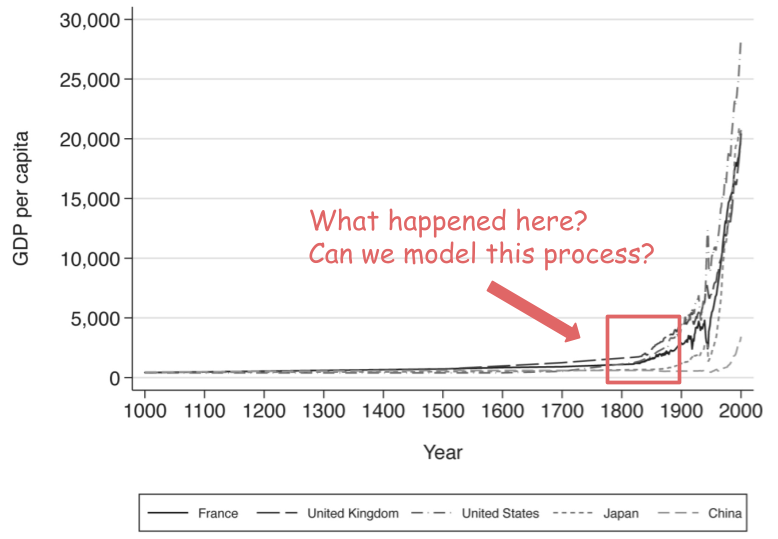
And then, remarkably, everything changed. Beginning roughly two centuries ago, with the industrial revolution, humanity entered what economic historians call the Great Takeoff: an unprecedented transition into sustained exponential growth in productivity, knowledge creation, and wealth accumulation. Most of the material and technological foundations of modern life emerged within this very short historical window. This raises one of the most profound questions one can ask about civilization:
What triggered the first Great Takeoff, and what might trigger the next?
The Takeoff (adapted from Fig. 2.1 in "The Power of Creative Destruction: Economic Upheaval and the Wealth of Nations" by Philippe Aghion et al.)
In his book "The Power of Creative Destruction: Economic Upheaval and the Wealth of Nations", economist and Nobel laureate Philippe Aghion argues that the Great Takeoff was not merely the result of a few lucky inventions, but the emergence of a new economic regime, one in which innovation became systematic, cumulative, and institutionally sustained through what Joseph Schumpeter called creative destruction.
Aghion's central conclusions can be summarized as follows:
Sustained growth begins when innovation becomes endogenous: Not an occasional accident, but a permanent engine driven by incentives, competition, and reinvestment.
Creative destruction is the fundamental mechanism of modern prosperity, as new technologies constantly displace old industries, firms, and modes of production.
Institutions and governance are necessary conditions, because innovation requires both freedom for disruption and social mechanisms that absorb its destabilizing effects.
The first Great Takeoff, in this sense, was a social-scale transformation: humanity discovered a way of organizing itself into a self-reinforcing innovation system.
From the First Takeoff to the Possibility of a Second
What makes this historical episode even more intriguing is the context in which it occurred. The first takeoff began when industrial development was still primitive. There were no computers, no modern scientific infrastructure, no venture capital, no global information networks. DNA had not been discovered, the moon was unreachable, and knowledge diffused merely at the speed of newspapers and ships. And yet, despite these limitations, the combination of technological breakthroughs, institutional evolution, and competitive economic dynamics produced an explosion of progress.
Today, we live in a radically different era. The internet has dissolved information barriers, global economies are deeply interconnected. Most importantly, AI is rapidly emerging as a new kind of cognitive actor and an increasingly indispensable member of society.
We are entering an age in which AI systems are no longer merely tools, but something closer to participants of the society: intellectual workers capable of reasoning, coding, designing, analyzing, and perhaps eventually discovering and innovating. This leads naturally to a series of new civilization-scale question:
If human society was able to trigger the first Great Takeoff, can this process be modeled and reproduced by AI technologies, and will an AI-augmented society trigger a second takeoff? If not yet, how far are we from such a possibility, what capabilities are missing, and what research and institutional changes are required?
AI as a New Cognitive Member of Society
The momentum of AI research and progress will not stop. Models will become smarter, cheaper, faster, and more deeply integrated into every sector of the economy.
But as AI capabilities increasingly approach or even surpass human cognitive performance in many domains, the central problem shifts. The question is no longer only how can we make AI smarter as an individual system, but a deeper question emerges: How do we maximize AI productivity at the scale of society, which is the ultimate goal of this technology?
In other words, we should begin thinking not only about isolated AI models, but about AI as a form of social infrastructure, a collective cognitive layer embedded in civilization.
The Prospect of a Second Civilization Takeoff
If AI fulfills even part of its promise, it will become the most powerful general-purpose technology (GPT) since electricity or steam. We can imagine a civilization where AI systems function as a new class of intellectual agents constantly pushing the innovation frontier, accelerating research, reducing development cycles, generating hypotheses and designs, and amplifying the productivity of human institutions. In this ideal case, the diffusion of AI as a GPT throughout society could initiate a new wave of exponential growth: a second Great Takeoff, driven not by mechanization of human labor as the first Great Takeoff, but by mechanization and amplification of cognition itself.
However, this is not a guaranteed outcome. To seriously entertain this prospect, we must inspect whether AI technology today is actually capable of modeling and reproducing the deep ingredients that triggered the first takeoff.
Can Current AI Model the Factors Behind the First Takeoff?
The first Great Takeoff was not caused by raw intelligence alone. It was caused by an innovation ecosystem with specific structural properties, as analyzed in Phlippe Aghion's "The Power of Creative Destruction". Sustained exponential growth emerged only when civilization developed a self-reinforcing regime of innovation, characterized by:
Endogenous technological progress: Science and engineering began co-evolving in a feedback loop, while mathematics enabled deeper understanding of "why", not just "how".
Rapid diffusion of knowledge: Ideas circulated more freely through books, journals, newspapers, postal networks, and expanding intellectual openness across nations.
Competitive entry and creative destruction: New firms displace incumbents, competition prevents stagnation and forces innovation.
Institutional support and social insurance: Education systems, labor mobility, property and patent protection, policies that reduce backlash and absorb disruption from industrial upheaval.
If AI is truly approaching human-level cognitive power, then in principle an AI society should eventually be able to reproduce similar dynamics. The question is whether current AI systems already capture these conditions. While much of the institutional and policy construction has matured over the last a hundred years, by comparing the historical takeoff conditions and the current cognitive and social collaborative capabilities of AI, the gaps become clear:
1. Innovation vs. pattern matching
Current AI systems are extraordinary at reasoning, synthesis, and recombination of existing knowledge, mostly via pattern matching. But they have not yet reached the level of reliably producing fundamentally new scientific theories on the order of the Theory of Relativity, paradigm-shifting engineering breakthroughs comparable to semiconductor manufacturing, and autonomous discovery grounded in experimentation like Penicillin. The cognitive capability required for true innovation remains incomplete.
2. Individual intelligence is not a society
The Great Takeoff was not the achievement of a single genius. It was the emergence of a collective innovation regime. Today's AI research remains overwhelmingly focused on improving individual agents, and while they become better in reasoning benchmarks, capable of solving harder math problems and autonomously coding for thousands of lines, civilization-level growth requires something more: A collective collaborative, evolving and competitive ecosystem, not individual and isolated models or agents.
3. Missing competition of creative destruction
Modern growth depends on competition, entry, failure, replacement, and renewal. Yet there is currently no real society-scale mechanism in which AI systems may compete as regulated economic actors, define and collaborate on long-term projects, competing and cooperating under shared rules, evolve and upgrade their capabilities collectively over time. AI today is powerful as individuals, but remains socially immature.
4. Communication, memory, and knowledge diffusion remain primitive
Civilizational takeoff requires innovations to diffuse rapidly and become reusable infrastructure. But today's AI systems lack persistent, shared collective memory and scalable collaboration protocols. The cognitive layer remains fragmented, as models do not yet form durable institutions of knowledge accumulation, but instead operate as disconnected, stateless intelligences.
From Individual AI to Collective AI: The Missing Research Frontier
We should therefore admit an important truth: There is still a significant gap between current AI and an AI society capable of triggering a second takeoff. The path forward requires expanding research beyond individual cognition toward collective intelligence.
In terms of individual cognitive modeling research, AI must become genuinely innovative so that it is able to generate novel hypotheses, validated via experiments and producing real scientific novelty. This is where more research effort will be focused on, and what we argued in previous essays (Innovation as the highest measure of intelligence, Break the closure limit).
But an even more critical missing piece lies at the collective level. To maximize social productivity in the AI era, AI systems must learn to operate as a society, not merely as isolated contributors. They must collaborate and divide labor, compete under safe rules, share and accumulate knowledge autonomously, self-improve through shared collective memory, and sustain innovation across generations of agents. Right now, this area of research remains largely underdeveloped. We have made remarkable progress in building smarter individuals, but not yet in building an innovation civilization - a true community of agents capable of cumulative, society-scale discovery. Although multi-agent system research has advanced rapidly, today's systems remain limited in coordination depth, task scope, and long-horizon productivity, falling far short of what would be required to support a second takeoff at the level of civilization.
Governance: Humans as Architects of the AI Society
Finally, none of this can happen without human governance. Creative destruction is powerful but destabilizing, and it must be structured. Humans must remain the ultimate architects and arbitrators of any AI society, who designs the regulatory frameworks, enforcing safety constraints, and ensure legitimacy and accountability.
We cannot allow uncontrolled AI acceleration, and the second takeoff must be governed and guided towards human flourishing and aligned with human principles.
Conclusion: Toward the Second Great Takeoff
The first Great Takeoff was humanity's discovery of an innovation engine at societal scale. One defining question for the remainder of the 21st century is whether AI can model and reproduce the core elements of the engine, ushering in a second takeoff that is collective, cumulative, and open-ended.
We are not there yet, and the gap is clear: Not only do we need further research to improve AI's cognitive capability, especially for open-ended innovation, but also ramping up the effort to transition from AI as isolated individual contributors to AI as a collaborative and evolving society. It's only under such a construction, that AI will become a self-reinforcing, endogenous engine for innovation and augment human civilization.
In this sense, the first Great Takeoff can be treated as the ultimate benchmark for a collective AI system. and this is perhaps the most important project civilization will ever undertake.